
Night Driving Glasses, Lenses & Tints: What the Evidence Says About Glare and Safety
Yellow lenses can make lights feel different, but that is not the same as showing better night-driving performance. Here is what current evidence supports, what it does not, and how to choose a safer next step.
If oncoming headlights feel harsher than they used to, it makes sense to look for a lens that promises to “cut glare.” The important question is what kind of glare you are dealing with and whether a lens feature has evidence for the outcome you actually care about: seeing the road, signs, pedestrians and other hazards clearly after dark.
For night driving, adding color is not automatically an upgrade. Any tint changes the light reaching your eyes. A lens can feel more comfortable without improving a safety-relevant visual task, so comfort claims and performance claims need to be kept separate.
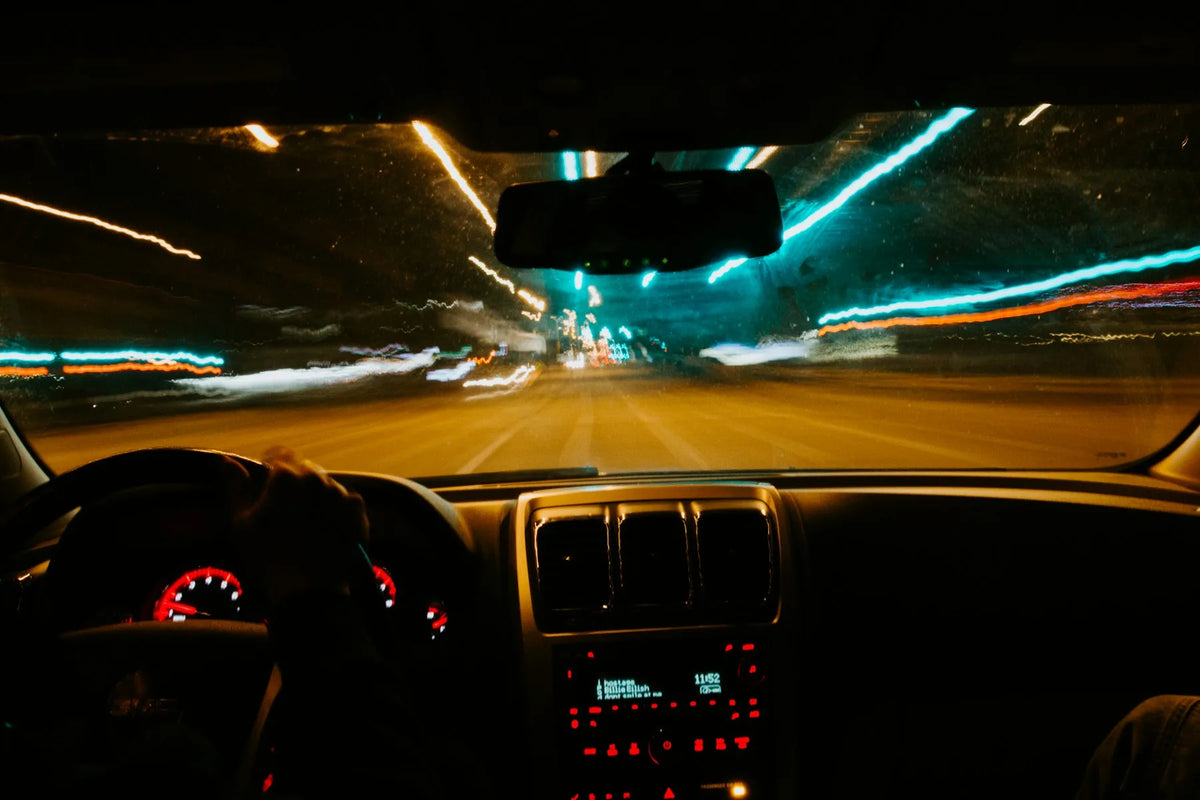
Why Night Driving Is Harder on Your Vision
Low light changes what your eyes have to detect
Night driving happens under much lower light levels than daytime driving. A peer-reviewed review of nighttime driving research found that visual function is reduced under mesopic—dim, in-between—lighting, and that the effect can become more pronounced with age or visual impairment. Headlight and road glare add another challenge because bright sources can make lower-contrast objects harder to pick out. Nighttime driving review (PubMed).
“Glare” can mean more than one thing
People often use “glare” for several different problems: reflections from eyeglass-lens surfaces, discomfort from a bright headlight, or a loss of contrast that makes an object harder to see. Those are related, but they are not identical. That distinction is why one feature can reduce reflections on the lens in front of your eye without proving that it improves every form of headlight glare.
Do Yellow or Amber Night-Driving Glasses Work?
What yellow tint changes
Yellow and amber filters reduce portions of shorter-wavelength light and change the color balance of the scene. Some users may describe the view as warmer or less harsh. But a change in appearance or perceived contrast does not automatically mean faster detection of a pedestrian, better recognition of a hazard or safer driving.
What the 2019 driving-simulator study found
Researchers compared three commercially available yellow-lens night-driving glasses with clear lenses while participants drove simulated nighttime scenarios with and without simulated oncoming-headlight glare. Across the study conditions, the yellow lenses did not produce better pedestrian-detection performance than clear lenses. Read the study in PMC.
Why “it feels less harsh” is not the same as better driving performance
That distinction matters in a safety guide. A driver may prefer the look of a colored filter, and a product may legitimately change the amount or spectrum of light reaching the eye. Neither fact is enough to claim that the product improves night vision, shortens hazard-detection time or makes driving safer. Safety claims need direct evidence for the safety-relevant outcome being claimed.
Claims vs. Evidence at a Glance
| Lens feature / claim | What it can reasonably mean | What the evidence supports | Practical takeaway |
|---|---|---|---|
| Yellow/amber “night-driving” tint | Can change color balance and may feel more comfortable to some wearers. | The 2019 simulator study did not show better pedestrian detection or reduced glare-related performance loss. | Do not treat yellow tint as a proven night-driving safety aid. |
| Anti-reflective coating | Reduces reflections from spectacle-lens surfaces. | Small older studies found contrast/comfort benefits under specific conditions; they did not establish crash reduction or guaranteed safety. | Reasonable lens feature for many eyeglass wearers, but keep the claim narrow. |
| Polarized sunglass lenses | Useful for reflected glare in bright daytime conditions. | Tinted sunglass lenses reduce available light; NHTSA advises against sunglasses or tinted lenses at night. | Think daytime glare control, not generic night-driving solution. |
| Photochromic lenses | Darken in response to light; activation behind a windshield depends on the product. | Many traditional UV-driven lenses stay clearer in a car; some products also react to visible light. | Follow the specific product label and do not assume all photochromics behave the same. |
| Transitions Drivewear | Adaptive polarized sun lens designed for daytime driving and outdoor use. | Manufacturer guidance says it is not suitable for nighttime driving and should not be worn after dusk. | Daytime only. |
| Blue-light filtering | Filters selected wavelengths. | The evidence in this guide does not establish a night-driving performance benefit from blue-light filtering. | Do not transfer screen-use claims to headlight-glare or driving-safety claims. |
Which Lens Features Make Sense at Night?
Clear prescription lenses: start with the correction you actually need
If you wear prescription glasses, the first question is whether the prescription is current and gives you the clearest correction available for your eyes. The National Eye Institute notes that refractive errors can cause blur, glare or halos, and people who still have symptoms while wearing glasses or contacts may need a new prescription. An eye exam is how that gets sorted out. NEI: Refractive Errors.
Anti-reflective coating: useful for lens reflections, not a cure for every kind of glare
Anti-reflective (AR) coating reduces reflections from the front and back surfaces of eyeglass lenses. That mechanism is directly relevant when some of the distracting light is coming from reflections on your own lenses. Small controlled studies from 1997 and 1999 reported better contrast sensitivity in a specific glare setup and strong subjective preference among highway patrol officers, respectively. Those studies were small, older and tied to specific lenses and conditions; they do not prove that AR prevents crashes or makes every driver safer at night. 1997 study. 1999 patrol-officer study.
Polarized lenses: valuable in bright daytime conditions, not a generic night solution
Polarization is especially useful for reflected glare in bright conditions, such as sunlight bouncing off roads, water or other horizontal surfaces. That is a daytime use case. For night driving, NHTSA advises older drivers not to wear sunglasses or tinted lenses because they reduce the amount of light reaching the eyes. That guidance is written for older drivers, but the optical principle is relevant more broadly: darker is the wrong direction when available light is already limited. NHTSA night-driving guidance.
Photochromic lenses: behind-the-windshield behavior is product-specific
Photochromic lenses do not all behave the same way in a car. Many traditional photochromic lenses respond primarily to ultraviolet light, and windshields filter much of that UV, so those lenses can stay relatively clear behind the glass. Some newer products also respond to visible light and can darken in the car. The product name and manufacturer instructions matter more than the generic word “Transitions.” Transitions product information.
Drivewear: a daytime driving sun lens, not a night-driving lens
Drivewear manufacturer guidance and Lensabl lens-replacement options are both worth checking when matching a product to its intended use.
Blue-light-filtering lenses: do not assume screen claims transfer to driving
A blue-light filter changes which wavelengths pass through a lens. That fact alone does not establish better night-driving performance or protection from headlight glare. This guide does not have evidence strong enough to recommend blue-light filtering as a night-driving safety feature, so it should not be presented that way.
Night vs. Day: How Common Lens Options Fit
| Option | Best-fit use | What it does | Night-driving boundary |
|---|---|---|---|
| Clear current prescription + AR | Night / everyday | Keeps the scene clear while reducing reflections from the eyeglass surfaces. | AR evidence is limited; no safety guarantee. |
| Yellow / amber tint | Not recommended as a proven night-driving aid | Changes spectral transmission and appearance. | Direct simulator evidence did not show better pedestrian detection. |
| Polarized sunglass lens | Bright daytime conditions | Controls reflected glare in sunlight. | Tinted sunglass lenses reduce light; not a generic night solution. |
| Standard photochromic | Everyday / daytime; product-dependent in car | Automatically changes tint with light exposure. | Windshield activation varies by product and generation. |
| Transitions Drivewear | Daytime driving / outdoor sun use | Designed to adapt in daylight and remain polarized. | Manufacturer says not at night or after dusk. |
| Blue-light filter | Product-dependent / general eyewear | Filters selected shorter wavelengths. | No established night-driving performance benefit in the evidence used here. |
How Much Tint Is Too Much for Night Driving?
Luminous transmittance in plain English
Luminous transmittance is simply the share of visible light that passes through a lens. A darker tint transmits less light. That can be helpful in bright sun, but night driving starts with much less light available, so reducing it further can work against the goal of seeing low-contrast objects.
What standards and safety guidance mean in practice
Optical standards distinguish lenses intended for bright conditions from lenses suitable for reduced illumination, and NHTSA explicitly advises against sunglasses or tinted lenses at night in its older-driver guidance. The practical consumer rule is simpler than a standards table: do not treat a dark tint as a night-driving aid, and follow the manufacturer’s specific day/night use instructions. Standards are not the same thing as state or federal law, so a standards threshold should not be presented as a blanket legal requirement.
If Night Glare Is New or Getting Worse, Check More Than the Lens
An outdated or incomplete prescription can matter
Blur, glare and halos can occur with refractive errors, and NEI advises people who still have vision symptoms while wearing glasses or contacts to talk with an eye doctor because a prescription may need updating. That does not mean every glare complaint is a prescription problem—it means choosing a different lens should not replace checking whether your correction is still right.
Astigmatism and other eye changes can affect night vision
Astigmatism can cause blurry or distorted vision and trouble seeing at night. Cataracts can make headlights seem too bright and can produce halos around lights. Those examples show why night-driving symptoms are not specific enough to diagnose yourself from a symptom list. NEI: Astigmatism. NEI: Cataracts.
When to book an eye exam
If night glare, halos, blur or difficulty seeing in low light is new, getting worse or making you question whether you can see the road safely, arrange an eye exam. An eye-care professional can check your prescription and look for eye changes that an online lens guide cannot diagnose. If you cannot see well enough to drive safely, do not rely on a tint or coating to compensate for that problem.
Practical Steps Before Your Next Night Drive
A few basic steps are more defensible than chasing a “night vision” lens claim:
Wear your current prescription if you need corrective lenses; do not fall back on an old pair.
Avoid sunglasses or visibly dark tinted lenses after dark.
Keep your windshield, mirrors and headlights clean, and make sure headlights are properly aimed.
If your glasses create distracting surface reflections, ask about an appropriate anti-reflective coating—without treating it as a cure for every kind of glare.
Check the specific manufacturer instructions for any photochromic or driving lens before using it at dusk or night.
If glare, halos, blur or night-vision difficulty is new or worsening, schedule an eye exam rather than self-treating with a colored filter.
Choosing Replacement Lenses Through Lensabl
If your prescription is current and you simply need new lenses in frames you already own, Lensabl offers lens replacement for existing frames. Its current lens-replacement flow includes clear lenses and lists Standard Lensabl AR as included. Those are product-availability facts—not proof that a particular Lensabl lens will solve an individual driver’s glare or make night driving safer.
You can also compare Lensabl lens options or contact Lensabl with product or order questions. For new or worsening vision symptoms, the right next stop is an eye-care professional.
Night-Driving Lens FAQs
What lens color is best for night driving?
For most drivers, the goal at night is not to add more color or darkness. Clear lenses with the correct prescription preserve available light. Yellow or amber lenses may change how the scene feels, but the strongest direct simulator evidence did not show better pedestrian detection with the yellow-lens products tested.
Are yellow night-driving glasses safe?
The evidence reviewed here does not establish that yellow night-driving glasses improve driving safety. The 2019 simulator study did not show better pedestrian detection with the yellow-lens glasses tested. Product suitability depends on the lens and the wearer, and a tint that meaningfully darkens the scene is difficult to justify for night use.
Is anti-reflective coating worth considering for night driving?
AR coating is a reasonable feature to discuss if reflections from your own eyeglass lenses are distracting. It reduces surface reflections, and small older studies found visual or comfort benefits under specific conditions. It should not be sold as an “anti-headlight” cure or a guarantee of safer driving.
Can I wear polarized lenses at night?
Tinted polarized sunglass lenses are designed for bright conditions, not as a generic night-driving solution. NHTSA advises against sunglasses or tinted lenses at night because they reduce the amount of light reaching the eyes. Follow the specific product label if you are considering a particular lens design.
Do Transitions or Drivewear work at night?
Photochromic behavior depends on the product. Many traditional photochromic lenses stay relatively clear behind a UV-blocking windshield, while some products can react to visible light in the car. Transitions Drivewear is different: its manufacturer describes it as a daytime driving sun lens and says it should not be worn at night or after dusk.
Why do headlights look like halos or starbursts?
Halos and glare can occur for several reasons, including refractive errors and eye changes such as cataracts. The symptom alone does not tell you the cause. If halos or starbursts are new, worsening or affecting safe driving, an eye exam is the appropriate next step.
Can Lensabl make lenses for night driving?
Lensabl offers clear replacement lenses and includes Standard Lensabl AR in its current lens-replacement flow. This guide does not recommend a special tinted “night-driving” Lensabl product or claim that any Lensabl lens makes a driver safer. If your prescription is current, clear replacement lenses can be the practical place to start.